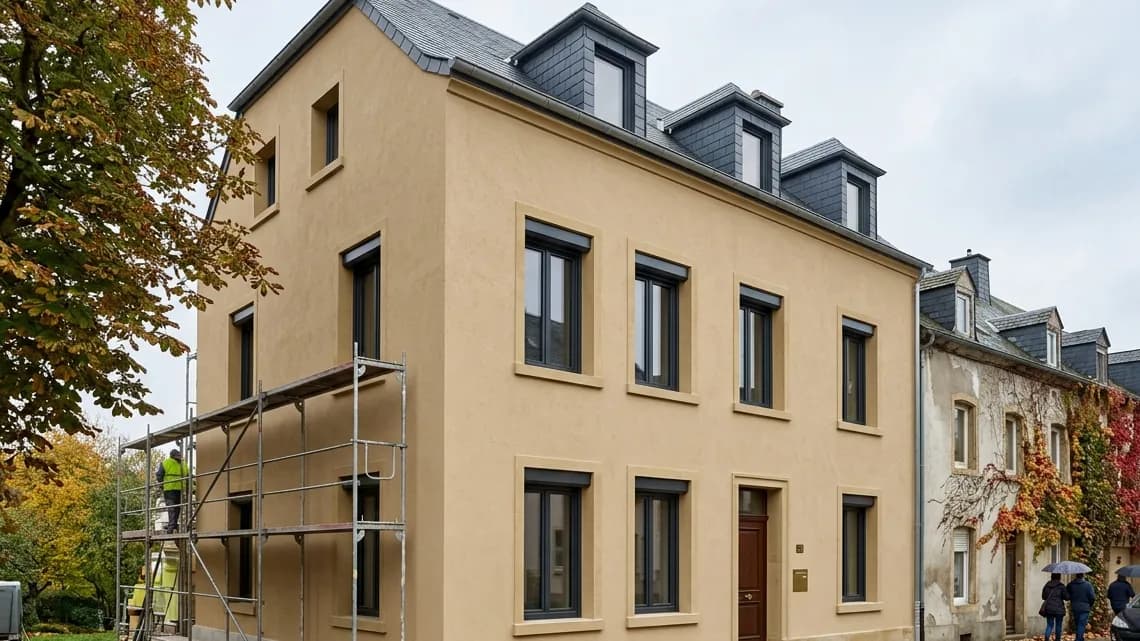
Bonded and mechanically fixed insulation boards
EPS, stone wool or wood fibre fixed to the substrate. Same principle as thin-render ETICS. The choice of insulation depends on fire and acoustic requirements and on the budget.

Thick mineral render (15-25 mm) over insulation — Weber, Parex (Monorex, Revlane), Diathonite, PRB. The most robust finish for external wall insulation. QUASART installs and specifies in Luxembourg, Moselle, Meurthe-et-Moselle and the Belgian province of Luxembourg.
Thick mineral render (15 to 25 mm) is the most robust finish for external wall insulation. Made from natural hydraulic lime (NHL) or lightweight Portland cement, it withstands impacts, driving rain and the weather without specific maintenance. Its natural porosity lets water vapour migrate freely — the wall breathes.
QUASART, based in Crauthem (L-3327), applies the Weber, Parex (Monorex, Revlane Granulat), Diathonite cork-lime and PRB ranges. These renders are applied over EPS, stone wool or wood fibre insulation, depending on the target thermal performance. Areas of operation: Luxembourg, Moselle (Metz, Thionville), Meurthe-et-Moselle and the Belgian province of Luxembourg (Arlon).
Each type of mineral render has its strengths — the choice depends on exposure and the desired look.
Lightweight one-coat mineral render — machine-applied in a single 15-20 mm pass. The quickest to apply. Floated, rubbed or pebble-dash finish. The standard for residential developments.
StandardApplied in two coats — bonding scratch coat (5 mm) + base coat (15-20 mm). The most robust technique, recommended for ground floors, highly exposed areas and older buildings. Specialist facade rendering skills.
TraditionMachine-applied cork-lime insulating render. Lambda 0.045, natural moisture regulator. Ideal for older buildings and bio-based projects requiring a mineral finish.
Bio-basedThick render based on natural stone aggregates — authentic stone-like finish. Parex Revlane Granulat, Weber Ton Pierre. Natural mineral appearance, resistant to impacts and weather.
PremiumThick mineral render offers authentic mineral textures that thin renders cannot reproduce.
QUASART works with the European leaders in mineral render.
The most specified one-coat render in Luxembourg. Ton Pierre (stone look), Cal (air lime). Machine application, even surface, wide colour palette.
Revlane Granulat range (high-resistance stone-finish render), Parexal (standard one-coat), Monorex GF (semi-lightweight one-coat). Enhanced resistance to algae and fungi thanks to a built-in biocide additive.
Machine-applied cork-lime insulating render. Lambda 0.045 W/m·K (Evolution). Natural moisture regulator that absorbs and releases humidity. Ideal for older buildings and ecological projects.
French manufacturer (Holcim Group). GF range (standard lightweight one-coat), Perméa (high vapour permeability), Thermolook (dedicated EWI render). Widely used in Luxembourg and Moselle. Logistical proximity within the Greater Region.
EPS, stone wool or wood fibre fixed to the substrate. Same principle as thin-render ETICS. The choice of insulation depends on fire and acoustic requirements and on the budget.
Scratch coat (thin, rough layer) sprayed onto the insulation to ensure adhesion of the base coat. Essential on smooth insulation (EPS). Can be replaced by metal lath on some systems.
Machine (render spraying machine) or hand application of the base coat at 15-25 mm. Ruled off with a straightedge, trued with a float. The heart of the system — it is this thickness that gives it its robustness.
Floated, rubbed, scraped, stone, sprayed and flattened, or Tyrolean. The finish coat is applied to the still-fresh base coat (wet-on-wet) or to hardened render, depending on the technique.
North- and west-facing facades in Luxembourg are prone to algae growth. Weber, Parex and PRB offer formulations with built-in biocides that keep the as-new appearance for 10-15 years.
Financial assistance is available through the Klimabonus for external wall insulation with R ≥ 3.7 m²·K/W. The type of render does not affect eligibility. Visit klima-agence.lu.
Thick mineral render requires specialist facade skills — thickness, drying and weather conditions are critical.
Checks on adhesion, flatness and moisture. Pull-off test on the insulation. Installation of the base profile and corner reinforcements.
Pull-off test · Base profileA rough scratch coat (3-5 mm) is sprayed onto the insulation. Minimum 24 h drying. This coat ensures the mechanical bond of the base coat.
3-5 mm · Rough · 24 h dryingMachine (render spraying machine) or hand application of the base coat at 15-20 mm. Ruled off with a straightedge. Thickness checked by laser.
15-20 mm · Machine · LaserFloated, rubbed, stone or sprayed finish, as chosen. Applied wet-on-wet or onto hardened render. Conditions: > 5 °C, no rain, no strong wind.
> 5 °C · No rain · Wet-on-wetEvery QUASART installation complies with the standards in force.
DTU covering mineral renders on various substrates — thicknesses, compositions, application conditions, quality control.
Reference DTU for render substrates — concrete block and brick walls. Defines the flatness requirements for the substrate.
European standard for rendering mortars — classification by type (GP, LW, CR), strength, adhesion, vapour permeability.
Approval guideline covering the whole EWI build-up — insulation, fixing, render. Basis for manufacturers’ ETAs.
Mineral render is classified A1 (non-combustible). The classification of the complete system depends on the insulation used.
Thick-render EWI is compatible with RE 2020 and Luxembourg’s GPE. R ≥ 3.7 for Klimabonus grants.
Thick mineral render withstands impacts from balls, trolleys and vandalism. Recommended on the ground floors of apartment buildings, schools and public buildings.
Thick mineral render reproduces the look of traditional renders — compatible with the built heritage of Luxembourg and Lorraine. Diathonite cork-lime for listed buildings.
West-facing (driving rain), north-facing (damp/algae) — the thickness of mineral render gives better protection than thin-render ETICS.
An alternative to thin-render ETICS when the client requires greater impact resistance. Parex Monorex GF or PRB GF for long facade runs.
Thick mineral render puts the robustness of tradition at the service of thermal performance. 15 mm of thickness that changes everything.QUASART — Installation philosophy
Upload a photo and get a free technical diagnosis in 60 seconds: material, condition, signs of wear, recommendations. No sign-up required.
Start my diagnosisEverything you need to know
Thick mineral render (15-25 mm) is more resistant to impacts and weather than thin-render ETICS (3-8 mm). It is recommended for ground floors, highly exposed areas and buildings subject to impacts. Thin-render ETICS is more economical and is sufficient for upper floors and less exposed facades.
Financial assistance is available in Luxembourg for insulation work. The Klimabonus programme can cover part of your investment if R ≥ 3.7 m²·K/W. The type of finish render does not affect eligibility. Visit klima-agence.lu.
Because of its thickness, mineral render retains more moisture than thin render — north- and west-facing facades can develop algae. Manufacturers (Weber, Parex, PRB) offer formulations with built-in biocides that keep the as-new appearance for 10-15 years.
Yes, with a suitable bonding undercoat and a reinforced mesh. Wood fibre (STEICO, Gutex) is an excellent substrate for mineral render — combining thermal lag with the robustness of the render. QUASART checks compatibility on every project.
The cost depends on the insulation, the render thickness and the finish. A thick-render system costs more than thin-render ETICS, but the greater durability justifies the investment, especially on ground floors and exposed areas. QUASART provides a precise quote after assessing the substrate.
Yes — scaffolding is essential for any external wall insulation. QUASART includes scaffolding in its estimate and coordinates its erection and dismantling with the other trades.