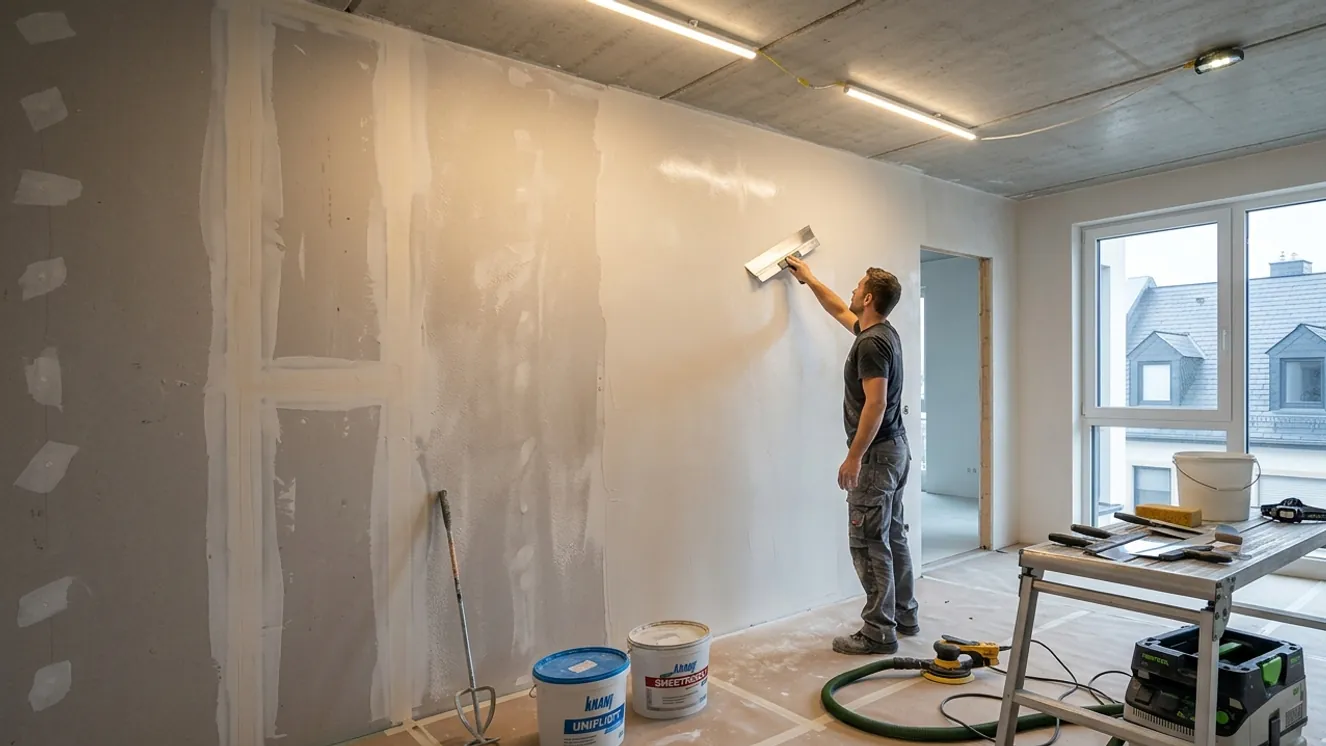
Interior skim coat
Knauf Multifinish, Placo Lutèce — spatula application on plaster or BA13. Fast drying, very smooth finish.

Skim coats, facade renders, floor levelling — Knauf, Weber, Parex, Sika. Perfect preparation determines the quality of the final result. QUASART in Luxembourg and the Greater Region.
Rendering is the preparation of surfaces before applying final finishes — paint, tiles, parquet, wallpaper. A poorly prepared surface — uneven, porous, cracked — irreversibly compromises the quality and durability of the finish.
QUASART, based in Crauthem (L-3327), provides interior rendering (skim coating, correction), exterior rendering (facade renders, waterproofing) and floor levelling (self-levelling, fibre-reinforced). Each substrate and end use has its product and technique.
Each surface type and final finish requires a specific render.
Spatula or trowel application — 1 to 3 mm. Fast drying. Very smooth finish, minimal sanding. The standard for all interior finishes.
FinishFiller for cracks, anchor holes, impacts, chasings. Fast setting (15-45 min).
RepairSingle or double coat facade render — 15 to 25 mm. Float, scraped, stone-effect. Custom colours.
FacadeSelf-levelling compound for uneven floors — 3 to 30 mm. Fluid pour, self-levelling. Substrate for tiles, parquet, PVC, resin.
FloorsRendering prepares the surface for the desired final finish.
QUASART works with reference manufacturers for each render type.
Complete interior render range. Multifinish (skim coat), Uniflott (jointing), Nivelite (floor levelling).
The widest range — interior, exterior, floors.
Facade coating specialist.
Structural repair and technical coatings range.
Knauf Multifinish, Placo Lutèce — spatula application on plaster or BA13. Fast drying, very smooth finish.
Knauf Uniflott, Sika MonoTop — cracks, holes, impacts, chasings. Essential preliminary steps.
Single or double coat depending on substrate condition. Cleaning, crack bridging, priming, application.
Parex Revlane, Weber.rep — flexible coating elasticity ≥ 1.5 mm. Bridges micro-cracks.
Weber Nivelit, Knauf Nivelite — self-levelling 3-30 mm. Substrate for tiles, parquet, PVC, resin.
Spatterdash or roughing on raw concrete before finishing. Corrects major defects.
Each rendering type follows a protocol adapted to the substrate and final finish.
Adhesion test, moisture measurement, defect survey. Selection of appropriate product.
Adhesion · Moisture · DefectsCleaning, dust removal, sealer. Bonding primer on smooth concrete. Bridging of active cracks.
Sealer · Primer · BridgingSkim coat: spatula or trowel, 1-3 mm. Levelling: self-levelling pour. Facade: machine spray, 15-25 mm.
Spatula · Pouring · MachineDry sanding (interior). Flatness check ±2 mm. Dust removal before finish.
±2 mm · Sanding · InspectionEvery QUASART rendering job complies with applicable standards and DTU.
DTU for interior and exterior mineral renders.
DTU defining surface preparation levels before painting.
DTU for sealed floor coverings — levelling must guarantee required flatness.
European standard for rendering mortars — classification, performance.
European standard for screed materials — compressive and flexural strength.
Products used hold CSTB Technical Approvals.
The core of rendering — skim coat on walls and ceilings before painting. Perfect surface = perfect paint.
Flatness correction of concrete substrate before tiles, parquet or PVC installation.
Facade render on degraded substrates — filling, waterproofing, painting.
Structural repair mortar (Sika MonoTop) for concrete spalling, exposed reinforcement.
Rendering is the work nobody sees — but everyone sees when it’s done badly. 80% of the final result is determined beneath the coat of paint.QUASART — Execution philosophy
Everything you need to know
On new BA13: 1 skim coat + sanding + primer. On raw concrete: spatterdash + body coat + finish (3 coats). On old walls: local correction + 2 skim coats.
Yes, and it’s often necessary. Floating parquet requires ±2 mm flatness under a 2 m straightedge. Self-levelling compound with ≥ 12 MPa compressive strength.
Standard levelling compounds go from 3 to 30 mm. Fibre-reinforced (Weber Nivelit Pro Fibré) can reach 50 mm in one pour. Beyond that, a screed is needed.
Rigid render does not seal active cracks. For micro-cracks (< 0.3 mm), a flexible coating (Parex Revlane, elasticity ≥ 1.5 mm) is the solution.
On smooth (shuttered) concrete: yes, mandatory (Knauf Betokontakt, Weber.prim). On rough porous concrete: a sealer is sufficient.
Levelling compounds dry in 24h for foot traffic and 3 to 7 days for finish installation. A 10 mm levelling dries in 2-3 days.