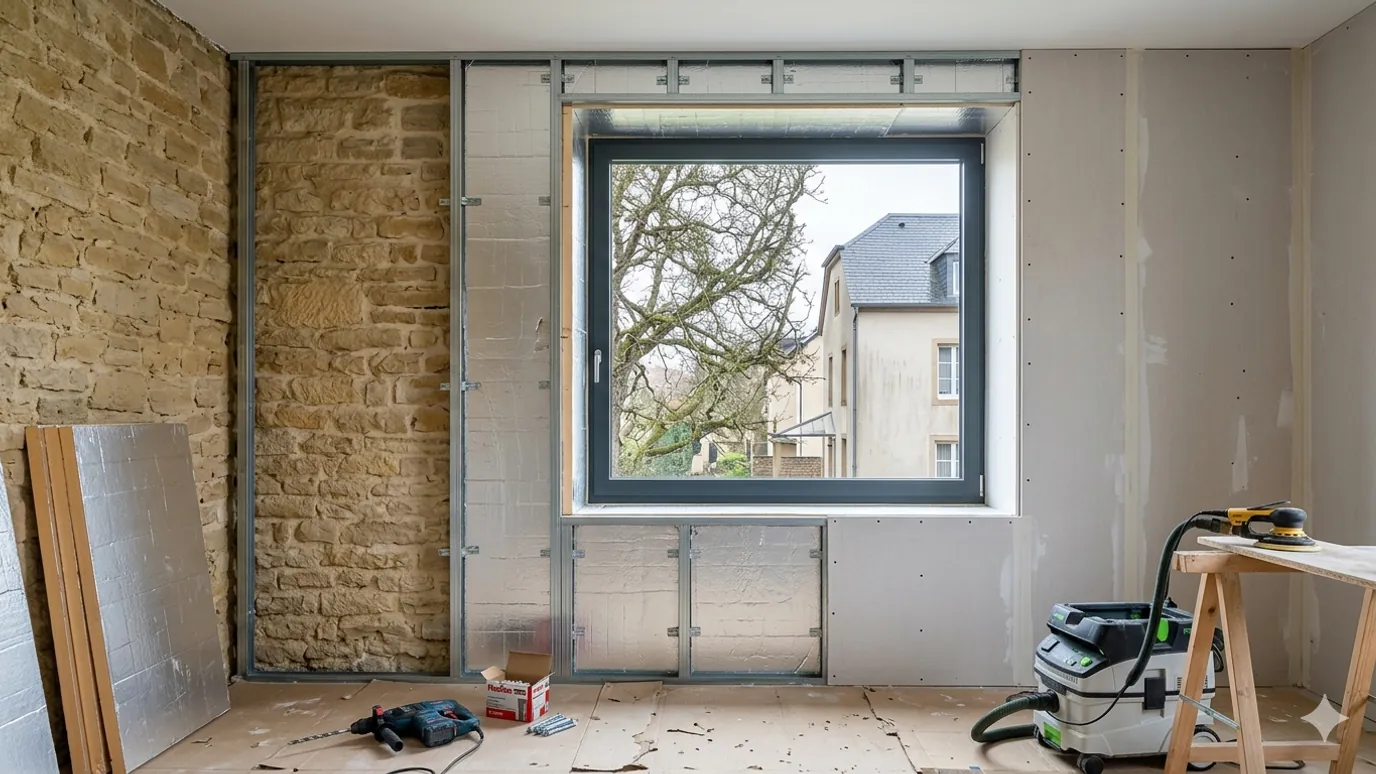
Metal frame drylining
Galvanised steel tracks and studs + rock wool or glass wool between studs + BA13 board. Integrated air gap. Best acoustic performance. Footprint 7 to 14 cm.

Metal frame drylining or bonded PIR composites — Knauf, ISOVER, Rockwool, Recticel. R ≥ 3.7 guaranteed. The solution when ETICS is not feasible. Luxembourg and Greater Region.
Interior thermal insulation (ITI) is the solution when ETICS is impossible — listed facade, co-ownership without vote, constrained budget, or simply a partial renovation project. QUASART carries out two types of ITI: metal frame drylining (with air gap) and insulation composites bonded directly to the wall.
QUASART, based in Crauthem (L-3327), optimises thickness to achieve R ≥ 3.7 with minimal footprint — typically 6 to 12 cm depending on the chosen insulation. Financial subsidies are available through the myenergy programme (Klimabonus) — visit myenergy.lu to check your eligibility.
The choice depends on available space, budget and acoustic requirements.
High-density panel on metal framework. Best acoustic performance for interior insulation. Non-combustible A1. Thickness 45 to 100 mm. Recommended for party walls and apartment buildings.
AcousticLowest lambda on the market (0.022). PIR composite + plasterboard bonded directly to the wall. R ≥ 3.7 in just 80 mm. Ideal for rooms where every centimetre counts. Integrated vapour barrier.
Minimal footprintSemi-rigid panel between metal framework. Good thermal/acoustic/cost compromise. Widely used for external wall drylining. Dust-free treatment and formaldehyde-free binder (ECOSE).
VersatileElasticised expanded polystyrene — economical bonded composite solution. Lambda 0.030-0.032 depending on grade. No significant acoustic benefit — reserved for external walls without sound requirements.
EconomicalThe finishing board depends on the room use and moisture constraints.
QUASART works with European leaders in interior drylining systems.
Complete drylining systems — insulation, metal profiles, plasterboards. Knauf TI 132 (high-performance glass wool), Knauf Therm (EPS), Knauf metal profiles. Vertical integration from rail to paint.
ISOVER range for interior drylining. GR 32 (panel lambda 0.032), Optima (dedicated framework system), Calibel (bonded composite with vapour barrier). Optima system = framework + insulation + membrane in one coherent system.
High-density rock wool panels for wall drylining. Rockmur (standard), Alphamur (high performance), Labelrock (bonded composite). Non-combustible A1, excellent sound attenuation. The choice for apartment buildings.
PIR (polyisocyanurate) panels — the lowest lambda on the market (0.022). Eurowall (bonded drylining), Powerwall (framework), Eurothane (roof). R ≥ 3.7 in just 80 mm. Integrated aluminium vapour barrier. Manufactured in Belgium.
Galvanised steel tracks and studs + rock wool or glass wool between studs + BA13 board. Integrated air gap. Best acoustic performance. Footprint 7 to 14 cm.
PIR composite panel + plasterboard, bonded directly to the wall. Minimal footprint — 5 to 8 cm for R ≥ 3.7. Ideal for small rooms. Integrated aluminium vapour barrier.
Rockwool Labelrock — HD rock wool + plasterboard bonded on dabs. More vapour-permeable than PIR — recommended for damp walls and natural stone masonry.
Thermal bridges (wall/floor junctions, window reveals) are treated with insulating profiles or spray foam. Without this treatment, gains are limited to 60-70% of potential.
BA13, moisture-resistant BA15, Fermacell — then jointing, skim, paint. QUASART handles all work from track to paint finish. One point of contact, one project.
Financial subsidies are available through myenergy (Klimabonus) for ITI with R ≥ 3.7 m²·K/W. Visit myenergy.lu to check your eligibility.
ITI installation requires attention to thermal bridges and airtightness.
Moisture, flatness and crack checks. Adhesion test for bonding. If the wall is damp, pre-treatment (drainage, injection) before any drylining.
Moisture · Flatness · CracksFramework: fixing top/bottom tracks + studs every 60 cm. Insulation between studs. Bonding: dab or full adhesive on PIR/wool composite, pressed onto wall.
60 cm · Dabs · PressingInsulation return at window reveals (min. 20 mm). Resilient peripheral strip at floor/ceiling. Spray foam at service penetrations. Vapour barrier membrane if on framework.
Reveals · Resilient · MembraneBoard screwing on framework or adhesion check on bonded composite. Jointing tape, skim coat, paint or wall covering. Surface-mounted sockets and switches.
Screwing · Jointing · FinishEvery QUASART drylining complies with applicable DTU standards and regulations.
Reference DTU for plasterboard facing works — metal frameworks, fixings, jointing, singular points.
DTU applicable to wall drylining with bonded composites (EPS, PIR, rock wool + plasterboard). Bonding, layout, junctions.
European standard for mineral wool insulation panels — declared lambda, thermal resistance, fire behaviour, water absorption.
European standard for polyurethane/polyisocyanurate insulation panels — lambda, thermal resistance, dimensional stability, fire behaviour.
Certified thermal certification — guaranteed lambda and ISOLE rating. Essential for subsidy application files.
Current thermal regulation — R ≥ 3.7 m²·K/W minimum for walls in subsidised renovation in Luxembourg.
When ETICS is prohibited by the municipality or heritage listing — ITI is the only option to achieve R ≥ 3.7. Bonded PIR composite to minimise footprint on living area.
Insulation of external-facing walls in a co-owned apartment — without general assembly vote, without touching the facades. The owner decides alone on interior works.
Insulation of a single room (cold bedroom, office) without renovating the whole building. ITI allows targeted, fast and cost-effective intervention.
When ETICS does not cover all walls (party wall, inaccessible blank wall) — ITI completes the overall thermal performance of the building.
Interior insulation is not a compromise — it is the smart solution when the exterior is not accessible. 80 mm of PIR is enough to transform wall comfort.QUASART — Philosophie de la mise en œuvre
Everything you need to know
No — ETICS remains the thermally superior solution as it eliminates structural thermal bridges (floors, partitions). ITI achieves R ≥ 3.7 but retains residual thermal bridges. However, it remains effective and represents a significant improvement over an uninsulated wall.
From 6 to 14 cm depending on the system. A bonded PIR composite (Recticel Eurowall) achieves R ≥ 3.7 in 7-8 cm. A framework drylining with 100 mm rock wool takes approximately 12-14 cm. In a 3×4 m room, that is 0.5 to 1.4 m² lost.
No — a damp wall must be treated before any drylining (drainage, resin injection, renovation render). Installing drylining on a damp wall traps moisture and creates mould. QUASART systematically carries out a moisture diagnosis before specification.
Financial subsidies exist in Luxembourg for wall insulation. The myenergy programme (Klimabonus) can cover part of your investment if R ≥ 3.7 m²·K/W. Visit myenergy.lu to check your eligibility.
With a bonded PIR composite: the aluminium vapour barrier is integrated into the panel. With framework drylining: a vapour barrier membrane (Sd ≥ 18 m) is recommended on the warm side, especially if the insulation is permeable (mineral wool). The Sd rule is critical to prevent condensation.
PIR (λ 0.022) offers the best thermal performance at minimal thickness — ideal when space is constrained. Rock wool (λ 0.035) is less thermally efficient but acoustically excellent and non-combustible (A1). QUASART recommends PIR for small rooms and rock wool for apartment buildings.