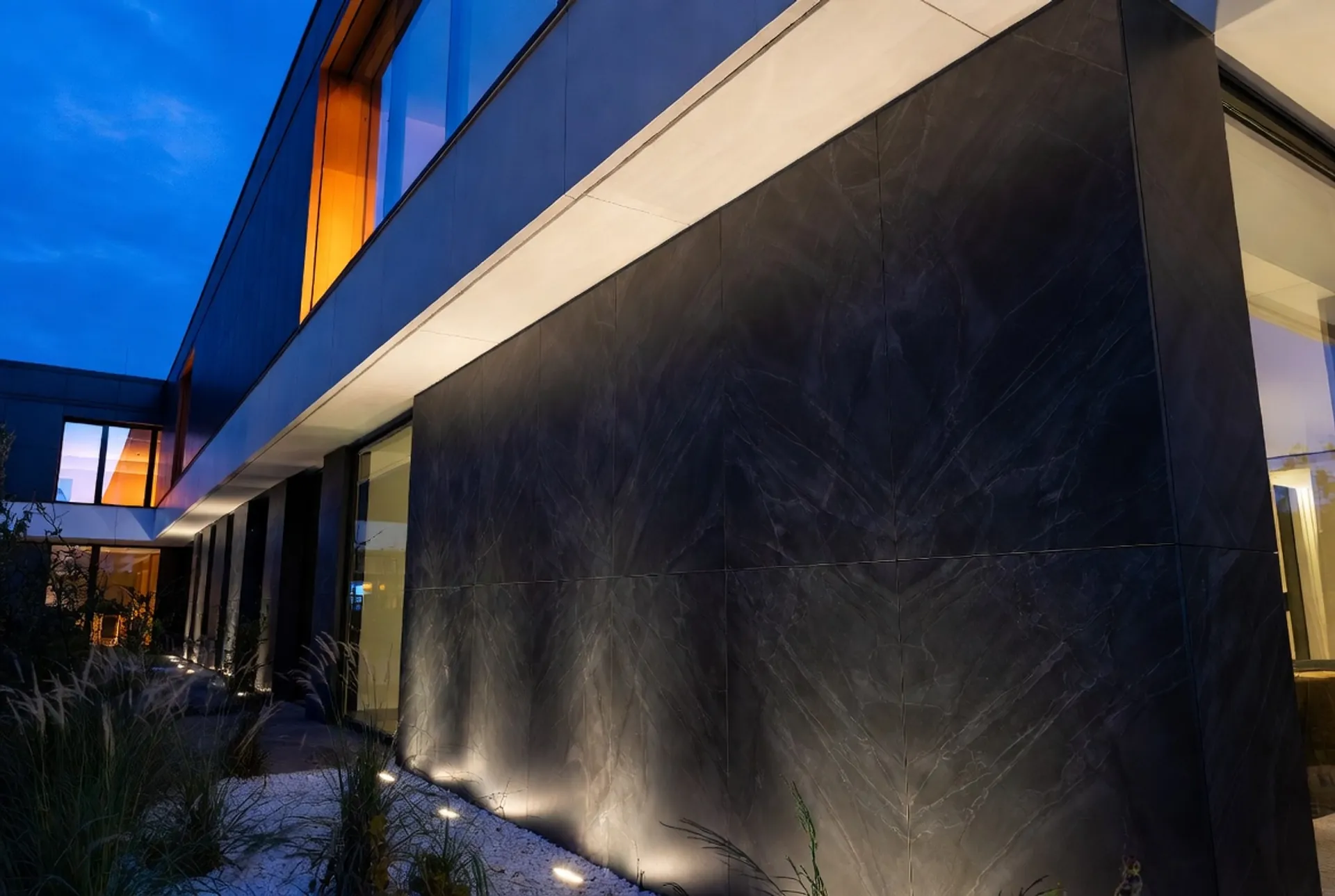
Invisible clip fixing
Groove routed into the back of the panel. Invisible stainless steel clips on aluminium rails. Perfect monolithic appearance — no fixing element visible on the facade. The standard for architectural projects.

Dekton (Cosentino), Neolith, Lapitec, Laminam — panels sintered at very high temperatures. Extreme resistance to UV, frost, scratches and fire. Formats up to 3,600 × 1,200 mm. QUASART installs and specifies in Luxembourg and the Greater Region.
Ultracompact panels — Dekton, Neolith, Lapitec, Laminam — are manufactured by sintering at very high temperatures. This process fuses minerals into a material of extreme density with near-zero porosity. The result: a panel of 8 to 20 mm thickness that resists UV without discolouration, freeze-thaw cycles without cracking, scratches without marking, and fire without propagation.
QUASART, based in Crauthem (L-3327), installs ultracompact panels on aluminium subframes with invisible or visible mechanical fixings. Large formats — up to 3,600 × 1,200 mm — enable monolithic facades of exceptional visual purity. We operate in Luxembourg, Moselle (Metz, Thionville) and Belgium (Arlon).
Ultracompact reproduces natural materials with striking fidelity — and incomparable resistance.
High-definition digital reproduction of the most sought-after marble veining. Perfect uniformity from panel to panel — impossible to achieve with natural marble. Dekton and Neolith lead this segment.
PrestigeRaw, polished or formwork concrete appearance without the constraints of real concrete — no cracks, no stains, no carbonation. Neolith Beton and Dekton Keon among the most accomplished.
ContemporaryReproduction of the oxidised metal appearance (Corten, aged copper, patinated bronze) without actual corrosion. Colour stable over time. Dekton Industrial and Neolith Iron.
IndustrialPlain colours (black, white, grey, anthracite) and natural stone effects (granite, slate, travertine). Lapitec Essenza for pure plains. The most understated and timeless choice.
ClassicThe ultracompact surface is the result of sintering — it does not scratch, yellow or stain.
QUASART works with the world leaders in sintered ultracompact panels.
Patented TSP sintered panel — blend of glass, porcelain and quartz sintered at 25,000 °C under 25,000 tonnes of pressure. Water absorption < 0.1%. Over 50 colours. Stonika format 3,200 × 1,440 mm.
Very large format sintered porcelain stoneware — up to 3,600 × 1,200 mm in 6 and 12 mm. NDD surface (protected HD digital printing). The widest variety of photorealistic decors on the market.
Full-body stoneware without resin, vacuum-sintered. The only ultracompact rated A1 non-combustible — essential for high-rise and public buildings without derogation. Italian manufacturing, premium quality.
Italian manufacturer of large-format ceramic slabs for ventilated facades. Formats up to 3,000 × 1,000 mm, thicknesses 5.6 and 12 mm. Extended architectural range — concrete, stone, oxide, fabric effects.
Groove routed into the back of the panel. Invisible stainless steel clips on aluminium rails. Perfect monolithic appearance — no fixing element visible on the facade. The standard for architectural projects.
Flush stainless steel rivets, regular pattern. Economical and demountable solution. Individual panel replacement possible. Used on budget-conscious projects or facades requiring technical access.
High-performance structural silicone. Result: monolithic facade with no visible metallic element. Requires strict surface preparation and quality control. Irreversible.
Anodised aluminium uprights and cross-members, 3D adjustable brackets. Air gap 30-60 mm. Integrated insulation. The complete system constitutes a high-performance ventilated facade.
Waterjet or CNC cutting for complex shapes, perforations and non-standard angles. QUASART relies on specialised workshops for precision cuts.
Open joints (3-5 mm) or closed joints depending on the architectural intent. Layout to the mm integrating large format management and offcut optimisation. Plan validated with the architect before ordering.
Ultracompact is a noble but demanding material — the slightest handling error is irreversible.
Large formats (3,200 × 1,440 mm) require layout to the mm to optimise offcuts (expensive material). QUASART produces the layout plan before ordering slabs.
Before ordering · Offcut optimisationHeavy panels (12 mm = ~30 kg/m²) and fragile in bending. Handling by suction cups, vertical storage on trestles. Any impact = panel lost — no repair possible.
Suction cups · Vertical · Zero impactDiamond disc or waterjet cutting for complex shapes. Back-face drilling for clips. Edges left raw or polished according to architectural detail.
Diamond · Waterjet · Polished edgesInstallation on laser pre-aligned aluminium subframe. Fixing by clips, rivets or bonding depending on the chosen system. Continuous plumb and flatness control.
Laser · Plumb · FlatnessUltracompact panels are certified according to the most demanding European standards.
European standard for sintered ceramic slabs — mechanical properties, water absorption, chemical resistance. Basis for CE marking.
Lapitec: A1 (non-combustible). Dekton and Neolith: A2-s1,d0. Laminam: A1 or A2 depending on range. Determines use in high-rise and public buildings.
DTU applicable to ceramic facade coverings — applicable by extension to ultracompact panels with clip or bonding fixing.
DTU applicable to ventilated facade systems — subframe, air gap, fixings. Complement to DTU 55.2 for mechanical fixings.
Series of ISO standards covering all ceramic tile tests: flexural strength, frost resistance, stain resistance, abrasion, chemical resistance.
Ultracompact panels in ventilated facades are compatible with RE 2020 and GPE Luxembourg. Thermal performance is ensured by integrated insulation.
Monochrome or marble-effect facades — absolute premium image. Dekton Stonika or large-format Neolith for a striking monolithic appearance. Guaranteed UV resistance — the facade does not change in 50 years.
Lapitec A1 non-combustible — the only ultracompact usable without restriction or derogation on high-rise buildings and all categories of public buildings.
Calacatta or Estatuario marble effect on facades — absolute luxury without the constraints of natural marble. Perfect batch uniformity. Intrinsic anti-graffiti.
Ultracompact as ventilated overcladding — replacing ageing render or cladding with a material that will not age. Structural survey before commitment.
Ultracompact is the definitive answer for architects who want a facade material that does not age, stain or burn.QUASART — Philosophy of materials
Dekton, Neolith, Lapitec, Laminam — everything you need to know
Dekton (Cosentino): TSP sintered panel at 25,000 °C, the most well-known. Neolith (TheSize): XL porcelain stoneware with high-definition NDD printing, the widest variety of decors. Lapitec: the only one rated A1, resin-free, vacuum-sintered — essential for high-rise buildings. Laminam: ultra-lightweight (5.6 mm), Italian large format. The choice depends on fire requirements, format and budget.
Yes. Water absorption < 0.1% — totally resistant to freeze-thaw cycles. An intrinsic property of sintering: pores are completely closed. All Dekton, Neolith, Lapitec and Laminam ranges are certified for unrestricted outdoor use in any climate.
Lapitec is rated A1 — suitable without restriction for high-rise and public buildings. Dekton and Neolith are A2-s1,d0 — compatible with most buildings subject to technical approval. QUASART verifies regulatory compliance for each project.
In supply terms, prices are comparable: 80-200 EUR/m² depending on format and finish. The advantage of ultracompact: perfect uniformity, superior mechanical resistance, no staining, no UV discolouration. Installation on subframe is similar. Total budget: 250-500 EUR/m² installed.
Yes — intrinsically. The near-zero porosity prevents any penetration of paint solvents. High-pressure cleaning or a mild solvent is sufficient. This is one of the most widely used materials on public buildings and transport for this reason.
Dekton Stonika: 3,200 × 1,440 mm. Neolith: 3,600 × 1,200 mm. Lapitec: 1,500 × 3,365 mm. Laminam: 3,000 × 1,000 mm. Thicknesses: 5.6 mm (Laminam), 6 mm (Neolith), 8-12-20 mm (Dekton, Lapitec). Large formats create a monolithic effect with no visible joints.