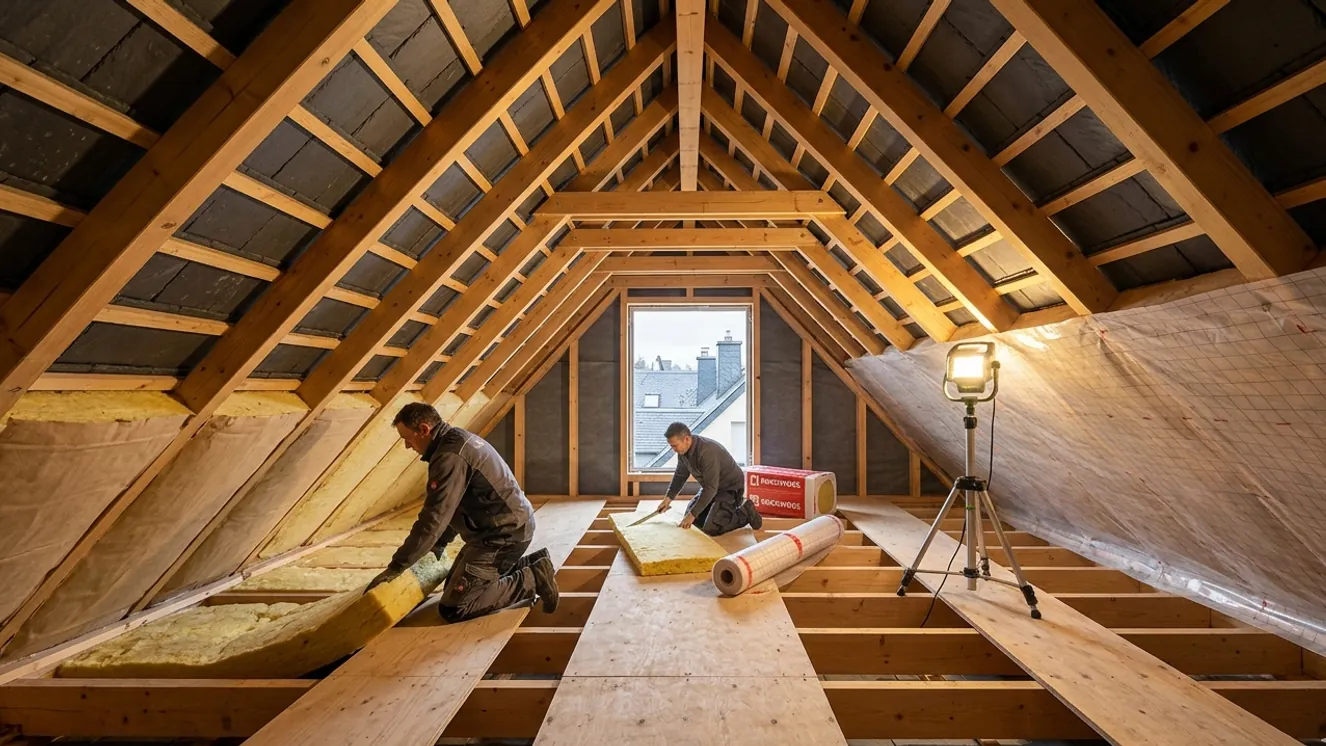
Under-rafter insulation
Converted or convertible attics — mineral wool or wood fibre between and under rafters. Thickness 200 to 280 mm for R ≥ 6. Interior vapour barrier mandatory (Sd ≥ 18 m). Plasterboard or panelling finish.

Under rafters and loft floor — Rockwool, Knauf, ISOVER, STEICO. R ≥ 6 to R ≥ 7 depending on configuration. QUASART insulates your attic in Luxembourg and the Greater Region.
The roof is the primary source of heat loss in a poorly insulated building — up to 30% of losses in winter. Conversely, it is often the most cost-effective intervention: unbeatable performance-to-cost ratio, work achievable without vacating living spaces, and a rapid return on investment.
QUASART, based in Crauthem (L-3327), handles all types of attic insulation in Luxembourg: converted attics (under-rafter insulation), loft spaces (blown-in or roll insulation on the floor) and convertible attics. Financial subsidies are available through the myenergy programme (Klimabonus) — visit myenergy.lu to check your eligibility.
The choice of insulation depends on the type of attic, budget and targeted summer/winter performance.
Non-combustible mineral insulation (A1). Excellent acoustic and thermal performance. Fire rating A2-s1,d0 in system. Available as panels, rolls and flakes for blowing.
Fire & acousticLowest lambda among mineral insulants (0.032). Lightweight, easy to install between rafters. Excellent performance-to-cost ratio. Flexible rolls for converted attics, flakes for loft blowing.
EconomicalRecycled newspaper treated with borax. Fast mechanical blowing (1 day for 100 m²). Good thermal lag (summer comfort). Integrated fire and mould treatment.
RecycledSemi-rigid wood fibre panel — exceptional thermal lag (12-16h in attics). The ideal choice for converted attics under roofs where summer comfort is critical. Negative carbon footprint.
Bio-basedThe finish depends on the type of attic and the intended use of the space.
QUASART works with the European leaders in insulation.
World leader in rock wool. Rockcomble (loft blown-in), Alpharock (semi-rigid panels under rafters), Rockmur (partitions). Non-combustible A1, excellent acoustic attenuation. Manufactured in Couvin (Belgium) — logistic proximity.
Complete range for attics. Unifit 035 (high-performance rolls), TI 135 (rigid panels), Supafil (blown glass wool). ECOSE technology — plant-based formaldehyde-free binder. Eurofins Indoor Air Comfort Gold certified.
Saint-Gobain Isover range for attics. Isoconfort 35 (rolls, lambda 0.035), IBR (economical rolls), Comblissimo (blown glass wool). Wide distribution network, permanent availability in Luxembourg.
Semi-rigid wood fibre panels for converted attics. STEICO Flex (between rafters, lambda 0.038), Joist (floor), Zell (blown cellulose). Exceptional thermal lag — the premium choice for summer comfort under roofs.
Converted or convertible attics — mineral wool or wood fibre between and under rafters. Thickness 200 to 280 mm for R ≥ 6. Interior vapour barrier mandatory (Sd ≥ 18 m). Plasterboard or panelling finish.
Cellulose wadding or mineral wool mechanically blown — thickness 300 to 400 mm for R ≥ 7. Fast technique (1 day for 100 m²), perfectly uniform, zero thermal bridges. No scaffolding required.
Manual laying of glass wool or rock wool rolls on the loft floor. Economical solution for open surfaces. Thickness 300 to 360 mm, cross-laid in two layers.
STEICO Flex semi-rigid panels between rafters — optimal thermal lag. Ideal for converted attics in timber-frame houses and high summer performance projects.
Insulated and sealed access hatch (forgotten thermal bridge = 10% of losses). Chimney ducts, ventilation, recessed lights — every singular point is carefully treated.
Financial subsidies are available through myenergy (Klimabonus) for attic insulation. Return on investment is estimated at 4 to 8 years depending on configuration. Visit myenergy.lu.
Installation differs depending on the type of attic — converted or loft.
Roof structure inspection, rafter spacing measurement, verification of under-roof ventilation. Identification of singular points (hatch, ducts, ventilation).
Structure · Ventilation · Singular pointsUnder rafters: semi-rigid panels wedged between rafters + additional layer below if necessary. Loft: mechanical blowing or cross-laying of rolls.
Rafters · Blowing · Cross-laidVapour barrier membrane on the warm side (Sd ≥ 18 m) under rafters — taped at junctions, sealed to walls. Loft: no vapour barrier if ventilated.
Sd ≥ 18 · Tape · JunctionsUnder rafters: metal framework + BA13 plasterboard or panelling. Loft: thickness control gauge, hatch marking, signage panel.
BA13 · Panelling · ControlEvery QUASART attic insulation complies with applicable DTU standards and regulations.
DTU standard for loft insulation by mechanical blowing — minimum thickness, installation density, control benchmarks.
DTU standard for panel and roll insulation in attics — layout, jointing, vapour barrier, singular points.
European standard for mineral wool insulation products — declared lambda, thermal resistance, mechanical strength, water behaviour.
European standard for loose-fill insulants (cellulose, blown wool) — installation density, settling, long-term thermal resistance.
French thermal performance certification — certified lambda, ISOLE rating. Guarantee that the installed product achieves stated performance.
European and Luxembourg regulations — minimum R-value required for attics depending on climate zone and building type.
Under-rafter insulation between and below rafters. STEICO Flex or Rockwool Alpharock for optimal thermal lag. The most common project in Luxembourg — 1 to 3 days depending on area.
Mechanical blowing of cellulose or mineral wool in one day. The most cost-effective insulation solution: reduced cost, R ≥ 7 easily achieved, no occupant disruption.
Insulation of the upper floor of the last inhabited level (communal loft). Coordinated intervention with the property manager. Reduced heating charges for all top-floor co-owners.
Insulation of office, school and retail attics. Rockwool rock wool required for A2-s1,d0 fire rating. Intervention possible outside business hours.
Attic insulation is often the first renovation step — and the most cost-effective. 30% of heat loss eliminated in one to three days of work.QUASART — Philosophie de la mise en œuvre
Everything you need to know
The Grand Ducal regulation and myenergy criteria recommend R ≥ 6 m²·K/W for converted attics (under rafters) and R ≥ 7 m²·K/W for loft spaces. These values correspond to approximately 220-240 mm and 280-300 mm of rock wool respectively.
Yes — this is the standard configuration. Insulation is carried out from the attic space, without any intervention in the occupied rooms. For loft spaces, mechanical blowing is completed in a few hours through the access hatch.
Glass wool has a slightly better lambda (0.032 vs 0.035) and is cheaper. Rock wool is non-combustible (A1), denser (better acoustics) and moisture-resistant. QUASART recommends rock wool for converted attics and blown glass wool for loft spaces.
Settling of 15 to 20% is normal in the first year. This is why EN 14064 requires an increased installation thickness (e.g. 350 mm installed to achieve 300 mm stabilised). QUASART systematically applies the manufacturer-recommended excess.
Financial subsidies exist in Luxembourg for attic insulation work. The myenergy programme (Klimabonus) can cover part of your investment. Visit myenergy.lu to check your eligibility and current conditions.
Under rafters (converted attics): yes, a vapour barrier on the warm side (Sd ≥ 18 m) is mandatory to prevent condensation in the insulation. Ventilated loft spaces: generally no — the natural ventilation of the loft is sufficient to evacuate water vapour.