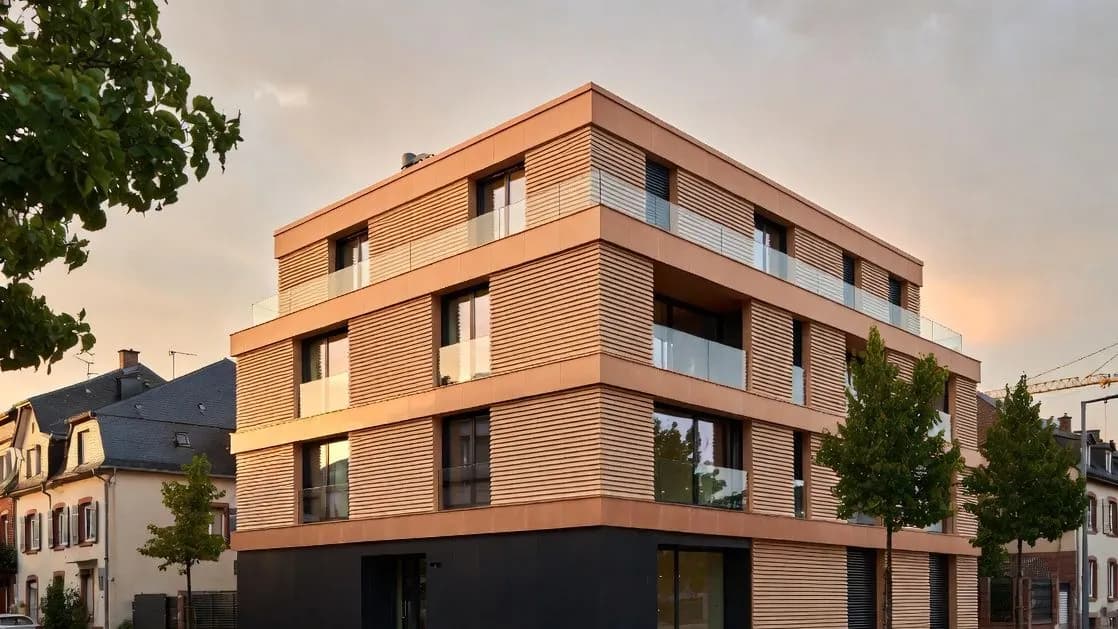
Vertical planks
The most common system — extruded planks installed vertically on aluminium rails. Strong rhythmic effect, interplay of light and shadow. Wienerberger Argeton, NBK Terrart Baguette.

Planks, panels, perforated screens — architectural terracotta in Luxembourg. Terreal, NBK Keraton, Wienerberger Terca, Moeding. Non-combustible, class A1. QUASART installs and specifies in Luxembourg, Moselle, Meurthe-et-Moselle and the Belgian province of Luxembourg.
Architectural terracotta has nothing in common with the traditional roof tile. Modern extruded planks are precision industrial components, fired at over 1,000 °C and designed for contemporary ventilated facades. Their natural porosity regulates moisture, their thermal mass stabilises temperatures and their A1 classification ensures fire safety.
QUASART, based in Crauthem (L-3327), offers the Terreal, NBK Keraton, Wienerberger Terca and Moeding systems. Areas of operation: Luxembourg, Moselle (Metz, Thionville), Meurthe-et-Moselle and the Belgian province of Luxembourg (Arlon).
The colour of terracotta depends on the clay composition and the firing temperature. Each kiln produces unique shades.
The original colour of terracotta. Deep, warm, authentic red. Stable over time — the pigments run through the body. The widest range of profiles available.
ClassicWarm colours reminiscent of Mediterranean architecture. Shades of yellow, beige and sand. Very popular for residential schemes and school buildings.
MediterraneanColours obtained with an engobe (mineral coating) or by firing in a reducing atmosphere. Light grey, slate, deep anthracite. A1 rating retained — no paint.
ContemporaryThe deepest terracotta colours. Chocolate brown, velvety black. A guaranteed dramatic effect. NBK Keraton and Moeding offer the most accomplished ranges in these tones.
PremiumTerracotta offers textures that only fired clay can produce.
QUASART works with the European leaders in architectural terracotta.
French leader in architectural terracotta. Piterak range (large elements), Aéra (openwork screens), Zephir (ventilating planks). The widest range on the market in profiles and colours.
German manufacturer of high-end architectural terracotta. Exclusive finishes, large formats (Terrart Large up to 2,000 mm), slim thicknesses (Slim 14 mm). Widely specified by architects on institutional and commercial projects.
The world’s largest brick manufacturer (Wienerberger group). Terca range of terracotta planks for ventilated facades. Optimal balance of quality and availability for large-volume programmes. European distribution network.
Bavarian manufacturer of high-performance architectural terracotta. Alphaton range (ultra-light large-format panels), Longoton (extra-long planks), Flexiton (curved elements). Constant technological innovation.
The most common system — extruded planks installed vertically on aluminium rails. Strong rhythmic effect, interplay of light and shadow. Wienerberger Argeton, NBK Terrart Baguette.
The same profiles installed horizontally — visually lengthens the volumes. Concealed or exposed fixing clips. Suited to villas and buildings of 3 to 7 upper storeys.
Extruded panels up to 2,000 × 600 mm — fast installation. NBK Terrart Large, Moeding Alphaton. Design joints, bevelled or square edges.
Perforated or cut-out pieces — light filtering, solar shading, privacy. NBK Claustra, Terreal Aéra. Brise-soleil integrated coherently into the facade.
Reds, ochres, browns, greys and blacks depending on the clay composition. Mineral engobes for bolder colours. A1 rating retained — no paint, no chemicals.
Anodised aluminium vertical and horizontal rails — adjustable clips, 40-60 mm air gap. Compatible with external insulation behind the cladding. System lifespan: 50-80 years.
Installing terracotta calls for specific expertise — a heavy material, sensitive to impact, with tight tolerances.
Installation drawing covering cuts, starting points, corners and junctions at openings. The bond (laying pattern) is defined with the architect — regular, staggered or random.
Before ordering · With the architectSubframe of anodised aluminium T-profiles, fixed to the substrate with adjustable brackets. Takes up irregularities in the supporting wall of up to 50 mm. Ventilated air gap of 40-60 mm.
Anodised aluminium · 40-60 mm · AdjustableStainless steel or aluminium clips specific to each manufacturer. Hung by sliding vertically — installed from the bottom up. Individual pieces can be replaced without removing the adjacent ones.
Bottom → Top · Individual replacementTerracotta is weather-resistant but vulnerable to impacts on site. Stored on pallets and handled with care. Edges protected during installation.
Impact-sensitive · Pallet storageEvery QUASART installation complies with the standards in force in Luxembourg and Europe.
Terracotta is classified A1 — a non-combustible material. Usable without restriction on high-rise buildings, public buildings and all other buildings.
Freeze-thaw test standard applicable to terracotta elements. More than 100 cycles guaranteed for certified products.
Standard applicable to large-format terracotta panels — mechanical properties, water absorption, chemical resistance.
Classification standard for terracotta building elements. Terminology, test methods, CE marking.
Terracotta is a natural material with high thermal inertia. Its mass contributes to summer comfort (thermal lag). Compatible with RE 2020 and the Luxembourg GPE.
Villas and architect-designed houses. Horizontal planks in natural colours — blending into the landscape, a premium material. Terracotta brings warmth without the upkeep of wood.
Residential schemes of 3 to 8 upper storeys. Vertical planks for a strong graphic effect. Custom colours using engobes. Lifespan of 50-80 years, no maintenance.
Museums, libraries, schools, sports facilities. A1 terracotta meets the strictest fire requirements. NBK and Moeding for signature projects.
Solar shading integrated into the facade — Terreal Aéra or NBK Slim openwork screens. Light filtering, visual privacy, architectural continuity of the terracotta.
Terracotta is the oldest material in the world — and the most contemporary. It never goes out of fashion, it does not age, it develops a patina.QUASART — Material philosophy
Upload a photo and get a free technical diagnosis in 60 seconds: material, condition, signs of wear, recommendations. No sign-up required.
Start my diagnosisTechnical aspects, maintenance and regulations
Yes. Architectural planks are fired at > 1,000 °C and tested to EN 539-2. Absorption coefficient < 3%, resistance to > 100 freeze-thaw cycles. The Luxembourg climate poses no problem.
Virtually none. Terracotta is an inert mineral material — no paint, no treatment. Pressure washing with water every 10-15 years is enough. Broken pieces can be replaced individually thanks to the clip system.
Yes, it is the recommended configuration. The air gap (40-60 mm) separates the cladding from the insulation. The vapour-permeable breather membrane protects the insulation. This build-up easily reaches BBC (low-energy building) and RE 2020 performance levels.
A1 under EN 13501-1 — the highest class, non-combustible. Usable without restriction on high-rise buildings, public buildings and all buildings subject to the strictest fire requirements.
Terreal (France): the widest range of planks and screens. NBK (Germany): premium, large formats, institutional. Wienerberger (Austria): best balance of availability and price. Moeding (Bavaria): innovation, lightweight panels, curved elements. The choice depends on the project.
The cost depends on the manufacturer, the profile and the complexity. Screens and NBK large formats are among the most expensive options. QUASART provides a precise quote after studying the project.